
In Dubai’s dynamic catering scene, where events range from lavish outdoor weddings under the stars to high-stakes corporate galas, maintaining impeccable food safety is non-negotiable. The region’s intense heat poses a constant threat to perishable items, making temperature control the most critical factor between a successful event and a hazardous situation. While refrigerated units are essential, their reach is often limited. Ice blocks emerge as a caterer’s most versatile and reliable ally for extending cold holding wherever needed. Far more than a simple cooling method, strategically deployed ice blocks form the foundation of safe, beautiful, and compliant buffet displays, transport solutions, and backup systems. This guide explores how professional caterers in Dubai can leverage ice blocks to guarantee food safety, enhance presentation, and meet stringent health regulations at every event.
The Critical Role of Temperature Control in Dubai Catering
Dubai’s climate creates a uniquely challenging environment for food safety. The “temperature danger zone,” where harmful bacteria multiply most rapidly, is between 5°C and 60°C. Outdoor ambient temperatures in Dubai regularly exceed this upper threshold for most of the year, meaning any food left outside without active cooling enters this danger zone in minutes, not hours. This makes passive cooling methods like simple shade completely inadequate for professional catering. Local municipal health regulations, enforced by authorities like the Dubai Municipality, mandate strict temperature controls for all food displayed or served to the public. Caterers must demonstrate that high-risk foods like dairy, seafood, poultry, and prepared dishes are held either below 5°C (for cold items) or above 60°C (for hot items) at all times.
Failure to maintain these temperatures carries severe consequences, including the risk of foodborne illness outbreaks, which can devastate a catering company’s reputation and lead to significant legal and financial penalties. Beyond compliance, consistent temperature control is a cornerstone of quality. It preserves the texture, flavor, and freshness of ingredients, ensuring that every dish served matches the chef’s intention. Ice blocks provide a powerful, flexible, and mobile solution to this challenge. They allow caterers to create safe cold zones anywhere—under a buffet chafing dish, within a display platter, or in a temporary holding station—effectively bringing the refrigerator to the food. This capability is indispensable for managing the fluid, often unpredictable flow of a large event where kitchen access is limited.
Ice Blocks vs. Cubes: A Food Safety and Efficiency Comparison
For catering professionals, the choice between ice blocks and cubes is a decision that impacts safety, efficiency, and operational smoothness. Ice cubes and flakes, while useful for chilling beverages, present several drawbacks for food safety applications. Their high surface area leads to rapid melting, which can create pools of water that compromise food packaging, dilute flavors, and create a soggy, unappealing presentation. More critically, this quick phase change means their cooling capacity is short-lived, requiring constant monitoring and replenishment during a long event—a labor-intensive and unreliable practice.
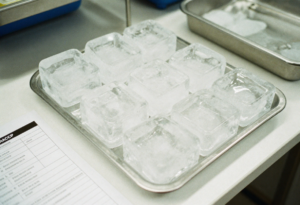
Ice blocks, in contrast, are engineered for sustained thermal performance. Their low surface-area-to-volume ratio ensures a slow, predictable melt rate. This provides a consistent cold temperature for many hours, creating a stable safety barrier against the “danger zone.” This reliability allows catering staff to focus on service rather than ice management. From a food safety perspective, the slow melt produces minimal water, reducing the risk of cross-contamination from splashing and keeping display garnishes and food containers dry and secure. Furthermore, blocks can be shaped and positioned strategically. They can be placed underneath elevated trays to create a cold air sink or hollowed to hold a container of dip or sauce directly within the ice, ensuring even the smallest perishable item remains safely chilled. This combination of endurance, stability, and strategic utility makes ice blocks the superior, professional choice for safeguarding food.
Calculating Ice Block Requirements for Different Event Types
Accurate calculation of ice block needs is a fundamental catering skill that balances food safety, presentation, and budget. There is no universal formula, as requirements shift dramatically based on event format, duration, and ambient conditions. For a standard indoor buffet with moderate kitchen access, the primary use is for display chillers and salad bars. A good starting point is to allocate one large five-kilogram ice block per linear meter of buffet table dedicated to cold items. This block typically provides a solid cold base for 3-4 hours in a climate-controlled ballroom. For an outdoor event, such as a garden wedding or poolside cocktail party, you must at least double this quantity. The intense heat and sun exposure demand more thermal mass to compensate for rapid environmental heat gain.
The event’s duration is the next critical multiplier. A four-hour dinner service requires a different plan than a twelve-hour exhibition stand. For long-duration events, you must implement a rotation system. This involves having a reserve of pre-chilled blocks in insulated containers to swap in at a predetermined interval, ensuring the displayed food never rises above 5°C. The type of food also dictates the strategy. A seafood display on a bed of crushed ice requires a massive underlying ice block foundation to keep the entire mountain cold. A simple cheese platter may only need a small, discreet block underneath the slate or tray. Always add a contingency factor of 20-25% extra ice to your final calculation. This buffer accounts for delays, higher-than-expected temperatures, or the need to cool beverages in a pinch. Precise planning prevents the critical error of running out of cold, which is a direct threat to food safety.
Strategic Display: Building Safe and Stunning Buffet Presentations
The art of catering lies in merging safety with spectacle, and ice blocks are a prime tool for achieving both. A strategic display begins with the foundation. For classic seafood or salad displays, use a deep hotel pan or a custom-built display vessel. Place a large, solid ice block at the very bottom as your primary cooling engine. Then, cover it with a layer of crushed ice or ice flakes. This top layer provides an aesthetically pleasing, textured bed that holds food in place while the hidden block underneath ensures the entire mass remains safely frozen for hours. The block does the heavy lifting of temperature control, while the crushed ice offers presentation and easy positioning of items like oysters or prawns.
For elegant canapé or dessert stations, a more discreet approach is needed. Use smaller, sculpted ice blocks or “ice bricks” as pedestals. Chill a marble slab or a mirrored tray by placing ice blocks underneath it, creating a beautifully cold surface for arranging delicate pastries, sushi, or cheese without any visible ice. Another professional technique is the ice well. Hollow out a cavity in a large block to securely hold a stainless steel container of dip, caviar, or a sauce bottle, keeping the contents perfectly chilled while integrating them into the display. Always ensure that any food container in direct contact with ice is waterproof and that drainage is planned to channel meltwater away from the food and into a concealed collection tray. This method prevents sogginess and cross-contamination. By thinking of ice blocks as structural and thermal components, you can design breathtaking displays that are as safe as they are impressive.
Sourcing and Logistics: Reliable Ice Block Supply for Caterers
For a catering business in Dubai, a dependable ice block supply chain is as crucial as a reliable produce vendor. Your operational integrity depends on it. Professional caterers should partner with industrial ice manufacturers or specialized catering supply companies that produce clear, food-grade block ice from filtered water. These suppliers understand the scale and punctuality required by the events industry. They typically offer blocks in standardized, heavy-duty weights like five, ten, or twenty-five kilograms, which are manageable for staff with proper equipment and provide the necessary thermal mass. Establishing a standing account with a reputable supplier ensures priority service, consistent quality, and often, better commercial terms.
Logistics planning is where theory meets reality. Delivery timing is critical; ice blocks should arrive as close to your load-out or setup time as possible to minimize pre-event sublimation. Coordinate precise delivery windows to your kitchen or directly to the venue if access permits. Have a dedicated handling and storage protocol upon arrival. Designate a freezer or a heavily insulated holding area for the blocks until deployment. Staff must use gloves and trolleys to move them safely, preventing injury and maintaining hygiene. For large-scale events, consider a staggered delivery schedule. An initial delivery covers setup and the first half of the event, while a second, smaller delivery provides fresh blocks for rotation or extended service. Always confirm the supplier’s emergency contact and after-hours delivery capabilities. A professional partnership means they understand that if your event runs late, you may need an urgent top-up, and a reliable supplier will have a contingency plan to support your business.
HACCP Principles in Action: Using Ice Blocks for Compliance
Implementing a Hazard Analysis Critical Control Point (HACCP) plan is a best practice and often a regulatory expectation for professional caterers. Ice blocks are a tangible control measure within this systematic approach to food safety. The first principle, Conducting a Hazard Analysis, identifies that “time and temperature abuse” is a significant biological hazard during display. The corresponding Critical Control Point (CCP) becomes the point where cold food is held on display. Here, ice blocks serve as the critical limit: the food must be held at or below 5°C, and the sufficient mass of ice blocks is the control to achieve this.
To fulfill HACCP requirements, you must establish monitoring procedures. This involves not just having the ice, but actively checking. Staff should use calibrated probe thermometers to regularly measure the temperature of food items within the display, not just the air nearby. They should also monitor the ice blocks themselves for signs of excessive melting, which would indicate a loss of control. Corrective actions are predefined steps if monitoring shows the temperature rising. This includes immediately replacing the melting ice blocks with fresh, pre-chilled reserves from backup storage, or removing the food to a refrigerated unit. Finally, verification and record-keeping are essential. Maintaining logs that document the times ice blocks were deployed, temperature checks performed, and any corrective actions taken provides auditable proof of your due diligence. This transforms ice blocks from a simple tool into a documented, systematic part of your food safety defense, demonstrating professional rigor to clients and health inspectors alike.
Beyond Buffets: Transport, Backup, and Specialized Uses
While buffet displays are the most visible application, the utility of ice blocks for caterers extends into crucial behind-the-scenes operations that ensure overall event safety. Transportation is a key area. Even with refrigerated vans, loading and unloading processes expose food to dangerous temperature spikes. Placing sealed containers of high-risk food directly on or beside large ice blocks inside insulated delivery crates creates a stable cold microclimate during transit and the chaotic setup period. This is especially vital for items like raw seafood, dressed salads, or delicate desserts that move from a central kitchen to satellite serving locations.
The concept of a backup cold reserve is a mark of professional preparedness. Every event kit should include extra ice blocks stored in heavy-duty insulated containers, separate from the display units. This reserve serves multiple purposes: it allows for the seamless rotation of blocks in displays as scheduled, provides instant capacity to cool down an unexpected batch of items, and acts as an emergency failsafe if a refrigerated unit malfunctions or power is lost. Furthermore, ice blocks enable specialized setups. They are perfect for creating impromptu cold stations for activities like sushi rolling, oyster shucking, or ice cream sundae bars directly in front of guests. For molecular gastronomy or cocktail catering, blocks can be carved into functional platforms or used to super-chill glasses and serving vessels. This versatility ensures caterers can adapt to any client request or venue limitation while maintaining the unbroken cold chain that is the bedrock of food safety.
Conclusion
For catering professionals in Dubai, ice blocks are far more than chunks of frozen water; they are indispensable instruments of food safety, operational flexibility, and creative presentation. In an environment where external heat is a constant adversary, the superior thermal mass and slow melt rate of blocks provide a reliable, compliant solution for maintaining the critical sub-5°C threshold. From precise calculation and strategic display building to robust sourcing and integration into HACCP plans, mastering their use elevates a catering service from good to exceptional. By leveraging ice blocks for transport, backup, and specialized applications, caterers can guarantee an unbroken cold chain from kitchen to guest, ensuring every event is not only visually stunning but also impeccably safe. In the high-stakes world of Dubai catering, this mastery is not just an advantage—it is an essential standard of professional practice.