
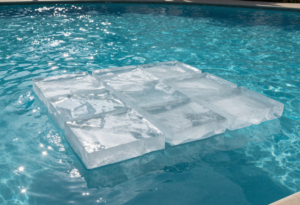
Dubai’s soaring summer temperatures present a unique challenge for pool owners. What should be a refreshing oasis often becomes a lukewarm bath, robbing you of that vital cooling plunge. Standard pool chillers are expensive to install and operate, while running the pump at night offers only marginal relief. There is, however, a remarkably direct and fast-acting solution gaining popularity: the strategic use of giant ice blocks. This method leverages simple physics to deliver a rapid temperature drop, turning an overheated pool into a cool, inviting retreat in a matter of hours. While it may seem unconventional, using large, commercially produced ice blocks is an efficient and increasingly accessible tactic in Dubai’s climate. This guide explores the science, logistics, and practical steps for using ice blocks to cool your pool, offering a fast-track to comfort during the hottest months.
Why Traditional Pool Cooling Falls Short in Dubai’s Heat
Traditional pool cooling methods often struggle to match the intensity of a Dubai summer. Ambient air temperatures that consistently hover above 40°C (104°F) and intense solar radiation create a massive thermal load on any body of water. Standard pool heat pumps running in reverse, known as pool chillers, are the most common technical solution. These systems, however, involve significant upfront costs for purchase and installation. Their ongoing operation also consumes considerable electricity, leading to high running costs that make continuous cooling prohibitively expensive for many residents. Furthermore, their cooling capacity has limits; on the most extreme days, a chiller might only lower the water temperature a few degrees below the ambient air, which may still feel unpleasantly warm.
Other passive methods, like using a pool cover at night to reduce evaporation heat gain or running fountain features to promote evaporative cooling, provide minimal impact. Nighttime cooling is marginal when overnight lows remain high, and evaporative cooling becomes less effective in Dubai’s often humid conditions. These methods simply cannot remove heat from the water quickly or deeply enough to counteract the constant energy input from the sun and hot air. This creates a frustrating scenario where your pool fails to deliver its primary function: relief from the heat. The need for a solution that acts quickly, without permanent installation or exorbitant energy bills, makes the concept of introducing a massive cold mass—like a giant ice block—a compelling and logical alternative for achieving a rapid, noticeable temperature change.
The Physics of Cooling: How Giant Ice Blocks Work in Water
The effectiveness of an ice block in cooling pool water rests on fundamental principles of thermodynamics, specifically heat transfer and latent heat. When you place a massive ice block into your pool, the cooling process operates in two powerful stages. First, the ice block absorbs sensible heat from the surrounding water. This direct transfer of energy raises the temperature of the ice while lowering the temperature of the water it contacts, creating a localized cooling effect. The second and more powerful stage involves latent heat of fusion. This is the substantial energy required to change the state of the ice from a solid to a liquid without changing its temperature. Water has a very high latent heat of fusion; it takes a significant amount of thermal energy from your pool water just to melt the ice.
This dual-phase action makes ice blocks exceptionally efficient coolants. The melting process acts as a massive heat sink, pulling a consistent and large amount of thermal energy from the entire pool volume as water circulates around the block. A standard one-tonne (1000 kg) ice block requires approximately 334 megajoules of energy to melt completely. This energy comes directly from your pool water, resulting in a measurable and rapid temperature drop. The melting is also a gentle, gradual process. It avoids the thermal shock and uneven cooling that could result from adding vast quantities of cold liquid. The ice melts steadily, distributing cold water in a controlled manner that, with the help of your pool’s circulation pump, mixes thoroughly to cool the entire body of water uniformly and effectively.
Calculating the Need: How Much Ice for Your Pool Size?
Determining the correct amount of ice for your pool is a crucial calculation that balances effectiveness with practicality. The goal is to achieve a noticeable temperature drop without causing excessive water displacement or wasting resources. The fundamental principle is that one kilogram of ice, when completely melted, absorbs enough heat to cool approximately 3.5 kilograms of water by about 80°C. However, your pool is not a lab experiment. In practice, a useful starting estimate is that one tonne (1,000 kg) of ice can lower the temperature of an average 50,000-litre pool by roughly 1 to 1.5 degrees Celsius. This accounts for real-world factors like ongoing solar heat gain and ambient air temperature.
To make a practical calculation, you must first know your pool’s volume in litres or cubic metres. You then decide on your target temperature reduction. For example, if you have a 75,000-litre pool and wish to lower the temperature by a significant 3 degrees Celsius, you might start with an estimate of 2 to 2.5 tonnes of ice. It is always wiser to start with a conservative amount, such as one tonne, and monitor the results. You can always add more ice later if needed. Remember that the ice’s effectiveness depends on your pool’s circulation. A well-functioning pump that moves water past the melting ice dramatically improves efficiency by distributing the cold water and preventing the formation of a localized cold pocket. Consider the initial water temperature as well. Cooling a pool from 36°C to 32°C is easier and requires less ice than cooling it from 32°C to 28°C, due to the exponential heat loss to the environment as the temperature difference increases.
Sourcing Giant Ice Blocks in Dubai: Practical Options
Sourcing a massive, commercially produced ice block is the key logistical step in Dubai. You cannot achieve the necessary thermal mass with bags of small ice cubes from a supermarket. Fortunately, several local industries provide the solution. Your primary sources will be industrial ice manufacturers, companies that supply ice to the fishing and food processing industries, and specialized event or catering suppliers that provide large blocks for displays and buffets. These companies typically produce clear, dense block ice in weights ranging from 25 kilograms up to one tonne or more. The one-tonne block is often the most practical and efficient unit for a residential pool cooling project.
When contacting suppliers, clearly specify you require a large, solid block of pure water ice for pool cooling, not dry ice or fragmented ice. Ask about the dimensions and weight to ensure you have a plan for handling and placement. Delivery is a critical service to confirm. Reputable suppliers will deliver the block on a pallet using a truck with a lift gate, and they may offer placement services with equipment like a forklift. Never attempt to move a one-tonne block yourself; it requires professional machinery. Plan your order for delivery shortly before you intend to deploy it, as the block will begin melting immediately upon leaving the factory. Have your payment and delivery details confirmed in advance, and ensure clear access to your pool area for the delivery vehicle. Building a relationship with a reliable supplier ensures you have consistent access to this unique resource whenever a heatwave strikes.
Step-by-Step Deployment: Safe and Effective Use
Safe and effective deployment of a giant ice block requires careful planning and the right equipment. The process begins well before delivery. You must identify the optimal placement location in your pool. The best spot is in the deep end, away from steps, ladders, and main drains, to allow for unobstructed water circulation around the block. Ensure the delivery path from the truck to the pool edge is completely clear of obstacles. Upon delivery, the block will likely be on a wooden pallet. Professional movers will use a forklift or a specialized dolly to transport it. Under no circumstances should you attempt to push or roll the block yourself, as its immense weight poses a severe crushing hazard and can damage your pool lining or coping.
The most controlled method for introducing the block into the water is to gently slide it off the pallet at the pool’s edge, allowing it to enter the deep end. Some professionals may use a crane truck for precise placement if access allows. Once the block is in the water, it will float due to the density difference between ice and water. Do not try to force it underwater. Its gradual melting from the top and sides is part of the efficient cooling process. Immediately turn your pool’s circulation pump to its highest setting. This constant water movement is critical. It carries warmer water from the surface and the rest of the pool to the ice block, maximizes the heat exchange rate, and distributes the newly cooled water throughout the entire system, preventing stratification. Monitor the block periodically, but maintain a safe distance to avoid any risk from shifting during melting.
Maximizing Efficiency and Minimizing Water Displacement
To get the most cooling effect from your ice block while managing the inevitable water addition, you need a strategy for efficiency. The primary goal is to maximize the surface area of the ice exposed to circulating water. While you should not break the block into pieces, positioning it directly in the flow of a pool return jet can significantly enhance the melting and heat transfer rate. If you have multiple return jets, adjust them to create a gentle circular current that moves water past the block continuously. Running your pool pump continuously for the 12 to 24 hours it takes the block to melt is non-negotiable for even cooling. This ensures the cold water integrates fully and you gain the maximum temperature drop from the latent heat energy.
Water displacement is the main side effect of this method. A one-tonne ice block will ultimately add approximately 1,000 litres of water to your pool upon melting. You must plan for this to avoid overflow, especially if your pool is already near its maximum level. Before deploying the ice, lower your pool’s water level by about 1.5 to 2 centimetres below the normal operating level. This creates the necessary buffer to accommodate the meltwater without flooding the surrounding deck or overloading the skimmer. After the ice has fully melted and the water has circulated thoroughly, you can test the temperature. You may then need to rebalance your pool chemistry, as the large influx of pure water can slightly dilute the concentration of salt, chlorine, and other chemicals. A simple water test and minor adjustment will restore perfect balance, leaving you with a comfortably cool and chemically safe pool.
Conclusion
Using giant ice blocks presents a brilliantly direct and fast-acting method to reclaim your pool from the oppressive Dubai heat. By understanding the powerful physics of latent heat, you can harness a one-tonne block to create a noticeable and refreshing temperature drop in a matter of hours. Success hinges on accurate calculation for your pool’s volume, secure sourcing from an industrial supplier, and safe, strategic deployment that maximizes circulation. While it requires planning and professional handling, this approach delivers immediate results without the prohibitive cost of a permanent chiller. For those blistering summer weekends when a lukewarm pool is simply not an option, an ice block serves as your most effective tactical tool. It transforms your pool back into the cool, inviting oasis it was meant to be, providing rapid relief and enhancing your outdoor living experience during the hottest months.